Introduction
We see objects falling every day and I suspect that most people who forget their schooling and just describe what they generally observe would agree that heavy objects fall faster than light ones and that they gain speed very quickly at first and then fall at a more or less constant speed. Such a description of falling objects is not wrong – it is in fact witnessed everyday – but it is not what is taught in science class. And that is because in science we have learned that our investigations of the natural world are always more successful if we simplify and focus our experiments by eliminating or at least accounting for circumstances that complicate our inquiries. In the case of falling objects, the confounding factor comes as a consequence of our inhabiting the bottom of a dense atmosphere: air retards the motion of objects and it does so more, the lighter they are and the faster they move.
Many natural philosophers before 1600 were well aware, contrary to the still zealously studied works of Aristotle, that objects fall at the same rate if they are not significantly affected by air resistance. Galileo Galilei (1564-1642) is noteworthy among these for two reasons; one, because he developed a mathematical description of free-fall, or natural acceleration as he termed it, and two, he confirmed that his mathematical model accurately described observation by doing experiments, something rarely thought necessary to that point in our history.
Galileo's Two New Sciences
Galileo’s work on natural acceleration is found in his Dialogues Concerning Two New Sciences, published in 1638[1]. These dialogues are the conversations of three people: Salviati, Sagredo and Simplicio. These characters were not introduced in Two New Sciences, but they were already familiar to readers of Galileo, having been presented in Dialogues Concerning the Two Chief World Systems (1632), as follows:
Many years ago I was often to be found in the marvelous city of Venice, in discussions with Signore Giovanni Francesco Sagredo, a man of noble extraction and trenchant wit. From Florence came Signore Filippo Salviati, the least of whose glories were the eminence of his blood and the magnificence of his fortune. His was a sublime intellect which fed no more hungrily upon any pleasure than it did upon fine meditations. I often talked with these two of such matters in the presence of a certain Peripatetic philosopher whose greatest obstacle in apprehending the truth seemed to be the reputation he had acquired by his interpretations of Aristotle.
Now, since bitter death has deprived Venice and Florence of those two great luminaries in the very meridian of their years, I have resolved to make their fame live on in these pages, so far as my poor abilities will permit, by introducing them as interlocutors in the present argument. (Nor shall the good Peripatetic lack a place; because of his excessive affection toward the Commentaries of Simplicius, I have thought fit to leave him under the name of the author he so much revered, without mentioning his own.) May it please those two great souls, ever venerable to my heart, to accept this public monument of my undying love. And may the memory of their eloquence assist me in delivering to posterity the promised reflections.
It happened that several discussions had taken place casually at various times among these gentlemen, and had rather whetted than satisfied their thirst for learning. Hence very wisely they resolved to meet together on certain days during which, setting aside all other business, they might apply themselves more methodically to the contemplation of the wonders of God in the heavens and upon the earth.[2]
The dialogues of these three characters take place over the course of “four days”. The first two days are occupied with the strength of materials, while the remaining two days cover the topic that interests us here, the science of motion. If you are able to obtain a copy of the book, I would encourage you to read the introductory passages, but then skip over the first two days to the third day. Don’t worry over all the theorems and propositions – Galileo did a thorough and wide-ranging investigation into the consequences of his ideas, a practice common at the time but, thankfully, no longer. I will copy sections of the text that I would particularly like you to read. Note that we are using the work of Galileo as a starting point for our investigation into mechanics; as such, this will be more of a summary of just a few of Galileo’s conclusions, rather than a detailed investigation into their historical development.
Introductory Notions
But let's begin our study of Galileo with the description of an experiment conducted sometime before 1600 by Guidobaldo del Monte (1545–1607), Galileo's senior and patron. The experiment is described as follows:
If one throws a ball with a catapult or with artillery, or by hand, or by some other means, above the horizontal line, it will take the same path in falling as in rising, and the shape is like that which, when inverted under the horizontal line, a ropes makes which is not pulled, being composed of both the natural and the forced, and it is a line which in appearance is similar to the parabola and hyperbola. . . The experiment of this movement can be made by taking a ball colored with ink, and throwing it over a plane of a table which is almost perpendicular to the horizontal. Although the ball bounces along, yet it makes points as it goes, from which one can see clearly that as it rises so it descends, and it is reasonable since the force it has acquired in its ascent operates so that in falling it goes in the same way, overcoming the natural movement in coming down so that the force that it overcame from B to C, conserving itself, operates so that from C to D it is equal to CB, and the force, descending and gradually lessening, is such that from D to E it is equal to BA, seeing that there is no reason to show that from E towards DE the force is at all expended that, although it lessens continually towards A , yet continues to be the reason why the weight never travels in a straight line towards E.[3]
I mention this experiment so that I can note how unusual it was! The dominant Aristotelian world-view strove to be a coherent, all-encompassing structure of logic, so that, prior to the seventeenth century, if one wanted to understand something about the world, then one studied the logic of the ancient Greek writings. One would not normally do experiments in order to draw one's own conclusions!
But this experiment is also important because it made a static record of the motion of the projectile that could be studied and pondered. And the most striking thing about the recorded path was its symmetry, which meant that the body must be moving according to mathematical rules. Suggestions were made by Guidobaldo to describe the shape of the path and Galileo did indeed eventually confirm that the curve was a parabola.
We see Galileo describing this experiment himself in the Two New Sciences at the end of the second day.[4]
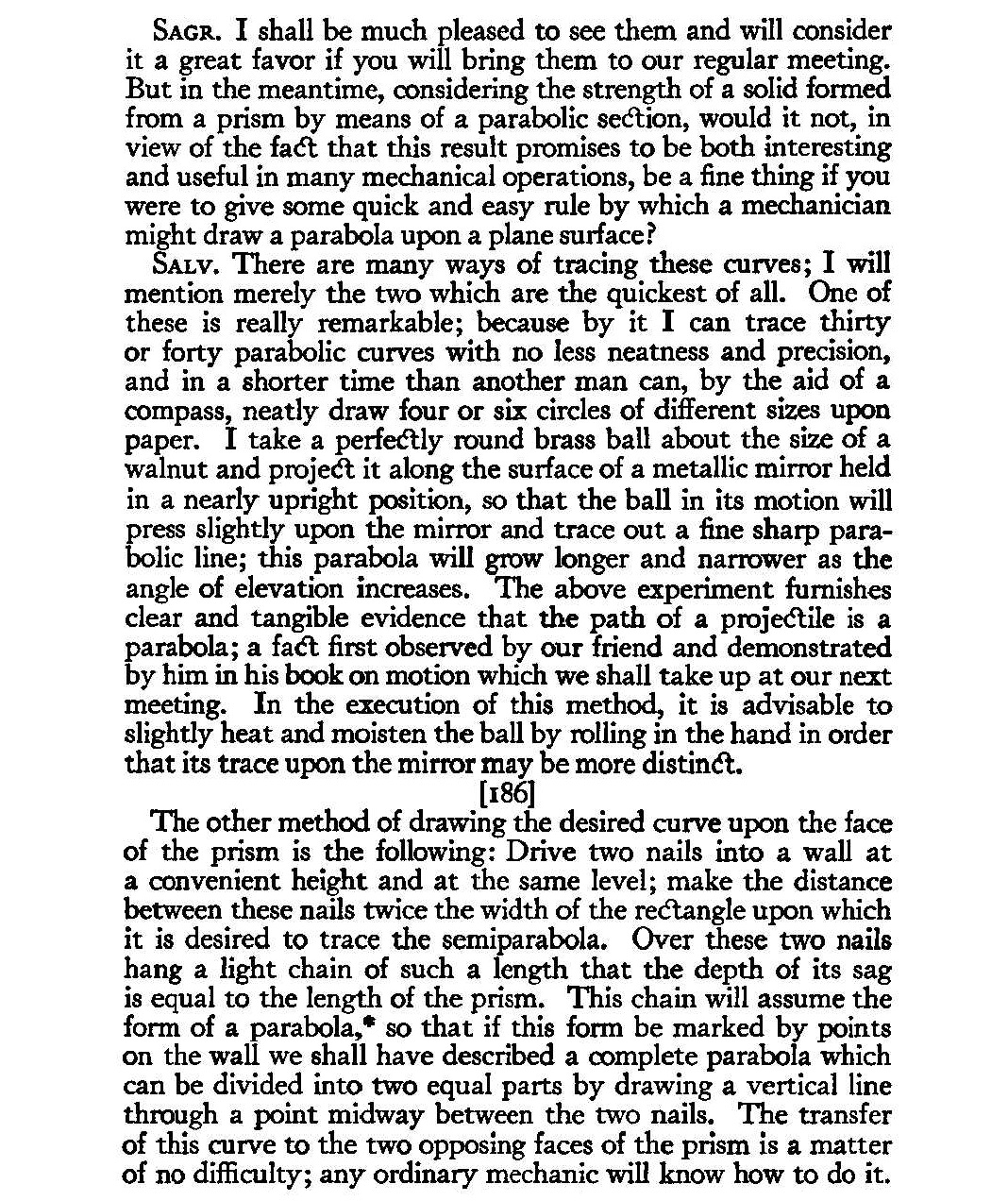
The second curve described by Galileo, formed by a hanging chain, is now known as a catenary and many historians, having read this passage, claim Galileo mistakenly believed that the parabola and catenary were identical. However, these scholars apparently did not read to the end of the book, where Galileo states that the two curves, while very similar, are not identical: [5]
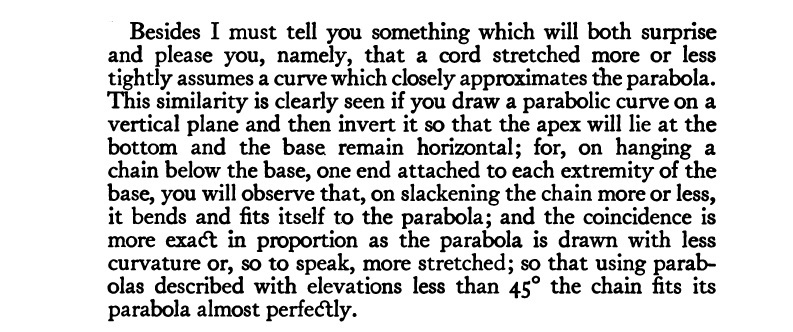
But we are digressing – as was said above, the symmetry of the path of a projectile indicates that it is moving according to mathematical rules. The fact that the path followed by the projectile as it is moving upward, when its speed is decreasing, is a reflection of the path moving downward, when its speed is increasing, indicates that the body's upward motion must decrease by the same amount as its downward motion increases. Indeed we can conclude, as Galileo did also, that the speeds of a projectile on its way up and on its way down must be equal at the same horizontal level![6]
Natural Motions
Galileo developed the analysis of a projectile further by separating the motion into vertical and horizontal components. While this may seem to be a rather surprising elaboration, it would come about quite readily even from the Aristotelian tradition. According to Aristotle, the heavenly objects, the stars and planets, moved in uniform circular motions about the centre of the Earth, while objects in the sub-lunar world had natural motions directed vertically either to or away from the centre. Galileo extended these ideas, if you will, with his experiments involving rolling balls on inclined planes, in which it was noted that a ball rolling on a horizontal, perfectly hard and smooth surface would, if all impediments were removed, continue in its motion indefinitely. We see this expressed in one of his Letters on Sunspots:[7]
For I seem to have observed that physical bodies have physical inclination to some motion (as heavy bodies downward), which motion is exercised by them through an intrinsic property and without need of a particular external mover, whenever they are not impeded by some obstacle. And to some other motion they have a repugnance (as the same heavy bodies to motion upward), and therefore they never move in that manner unless thrown violently by an external mover. Finally, to some movements they are indifferent, as are the same heavy bodies to horizontal motion, to which they have neither inclination (since it is not toward the centre of the earth) nor repugnance (since it does not carry them away from that centre). And therefore, all external impediments removed, a heavy body on a spherical surface concentric with the earth will be indifferent to rest and to movements toward any part of the horizon. And it will maintain itself in that state in which it has once been placed; that is, if placed in a state of rest, it will conserve that; and if placed in movement toward the west (for example), it will maintain itself in that movement. Thus a ship, for instance, having once received some impetus through the tranquil sea, would move continually around our globe without ever stopping; and placed at rest it would perpetually remain at rest, if in the first case all extrinsic impediments could be removed, and in the second case no external cause of motion were added.
This perpetual circular motion on Earth has an obvious correspondence with the circular motion of the heavenly bodies. Indeed Galileo brought this up in his Dialogue Concerning the Two Chief World Systems, in which he was arguing against the Aristotelian physics that distinguished between the ever-changing vertical motions of the sub-lunar world and the perpetual circular motions of the incorruptible heavens.
But I tell you that the circular motion which you assign to celestial bodies is also suited to the earth; from which, supposing the rest of your discourse to be conclusive, will follow one of three things, as I just finished telling you, and shall now repeat. Either the earth itself is also ingenerable and incorruptible, as are celestial bodies; or celestial bodies are, like the elemental, generable and alterable; or this difference of motion has nothing to do with generation and corruption.[8]
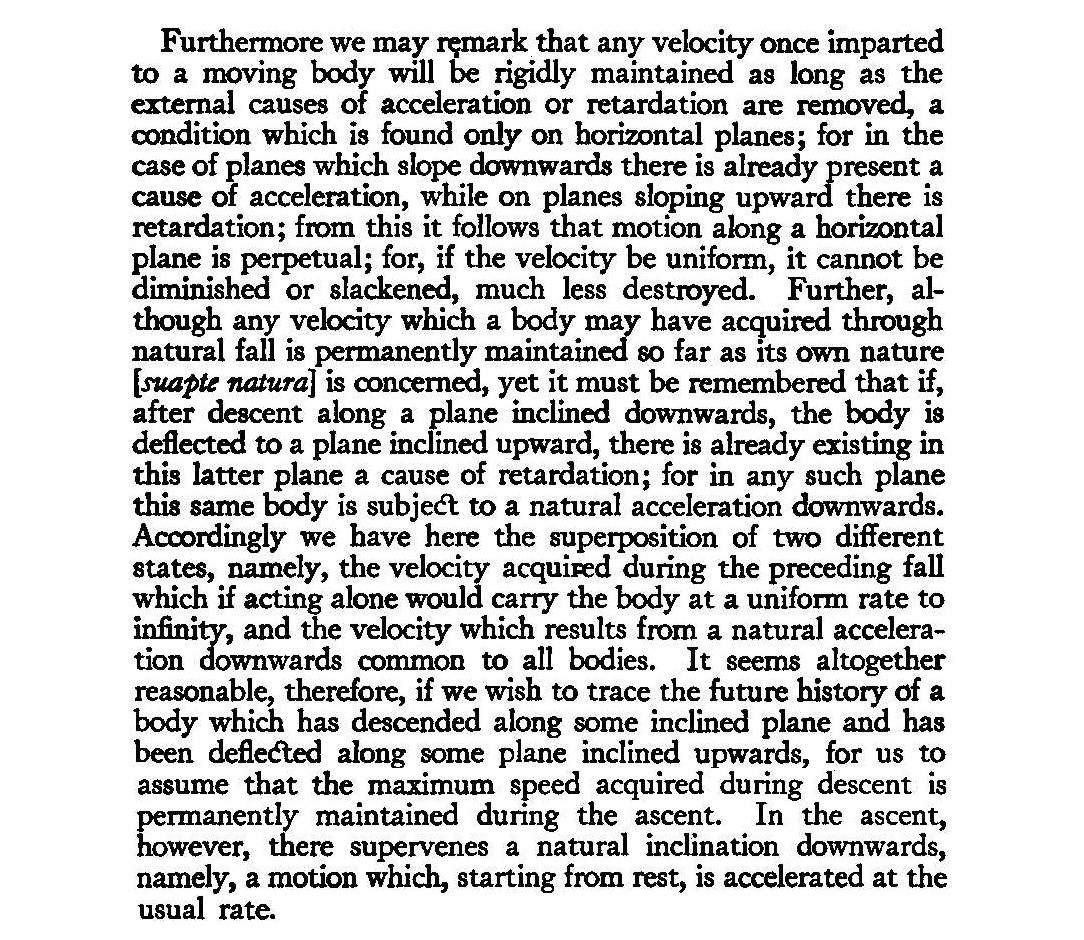
By the time Galileo wrote Two New Sciences he had expanded this concept of a passive circular motion to include motion in any direction, a concept nearly equivalent to our modern concept of inertia, but still lacking any kind of a magnitude. This can be seen in his comments below, in which he maintains that the motion of a body would continue unchanged if it were not acted on by a natural acceleration downwards.[9]
Notes
- Galileo Galilei "Dialogues Concerning Two New Sciences" 1638; Translated by Henry Crew and Alfonso de Salvio 1914; Reproduced by Dover Publications 1954.
- Galilei, Galileo 1632 “Dialogues Concerning the Two Chief World Systems”; The Modern Library, 2001. pp.6-7
- R.H. Naylor 1980 “Galileo’s Theory of Projectile Motion” ISIS 71 p.551
- Galileo (1638) ibid pp.148-149
- Galileo (1638) ibid p.290
- Naylor (1980) ibid p.552
- Letters on Sunspots 1612 reprinted in Discoveries and Opinions of Galileo, Stillman Drake, 1957, Anchor Books pp.113-114
- Galileo "Dialogue Concerning the Two Chief World Systems" 1632. Translated by Stillman Drake, Reprinted by Modern Library 2001. p.44
- Galileo (1638) pp.215-216